
Countering Violent Extremism in the Philippines: A Snapshot of Current Challenges and Responses
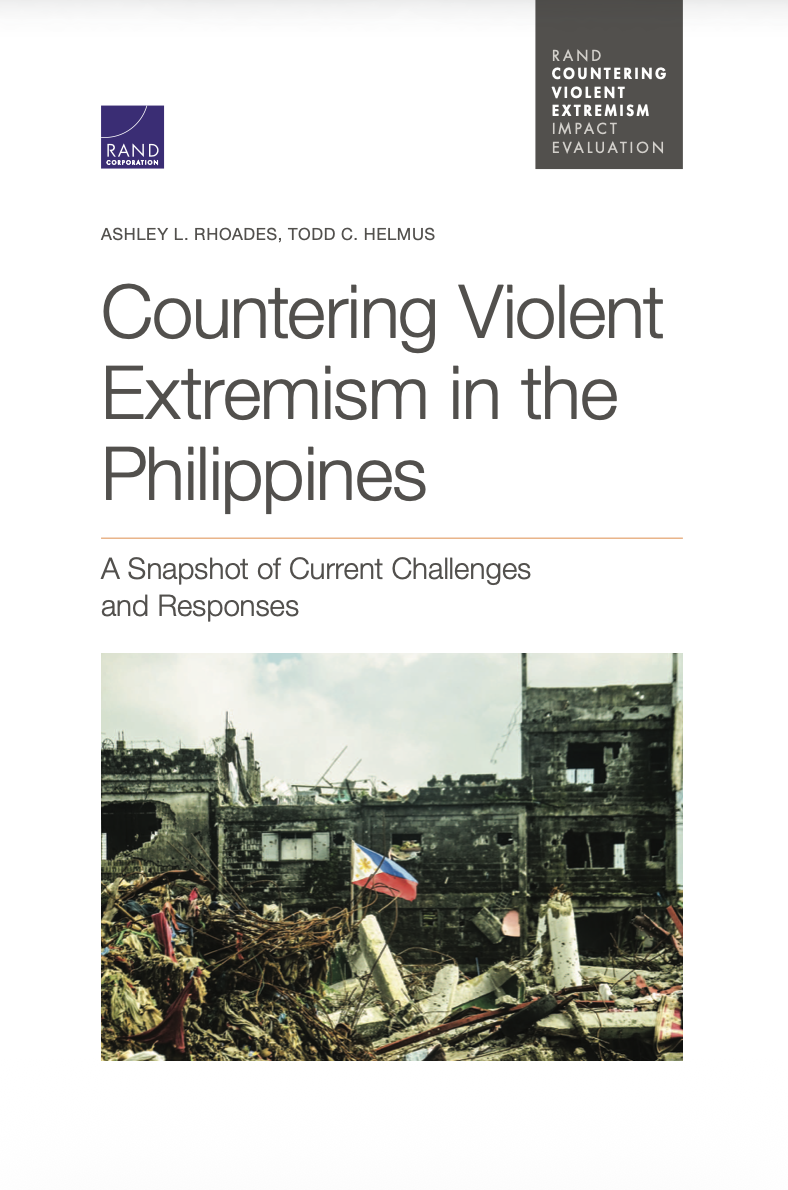
This RAND report provides a current threat picture and a survey of CVE programming in the Philippines, drawing on open-source literature. The conditions driving radicalization remain severe and persistent: entrenched poverty in parts of the country, Catholic-Muslim communal divisions, grievances with the government, and recurring armed conflict combine to create an environment where violent ideologies take root, and current CVE programming is not sufficient to push back.
The government response has erred in both directions. Heavy-handed kinetic measures under President Duterte risk further radicalizing frustrated populations, while non-kinetic government programming suffers from credibility deficits, limited judicial capacity, and poor coordination. Nongovernmental CVE work has produced some successes but tends to operate as microcampaigns without scale, and almost none of it is subjected to rigorous evaluation. The authors argue that future programming needs systematic monitoring and evaluation built in from the start if the field is going to learn what actually works.