
Searchable Publication List
The 2024 U.S. Election, Trust, and Technology: Preparing for a Perfect Storm of Threats to Democracy
Authors of a new paper identified key risks and potential threats, focusing on vulnerabilities associated with three types of assets required for fair, democratic elections: physical, human, and reputational.
Ukrainian Resistance to Russian Disinformation: Lessons for Future Conflict
This RAND report uses Ukraine's wartime information and counter-disinformation efforts as a case study to distill lessons for how the U.S. national security establishment can prepare for and counter Russian-style disinformation during future contingency operations.
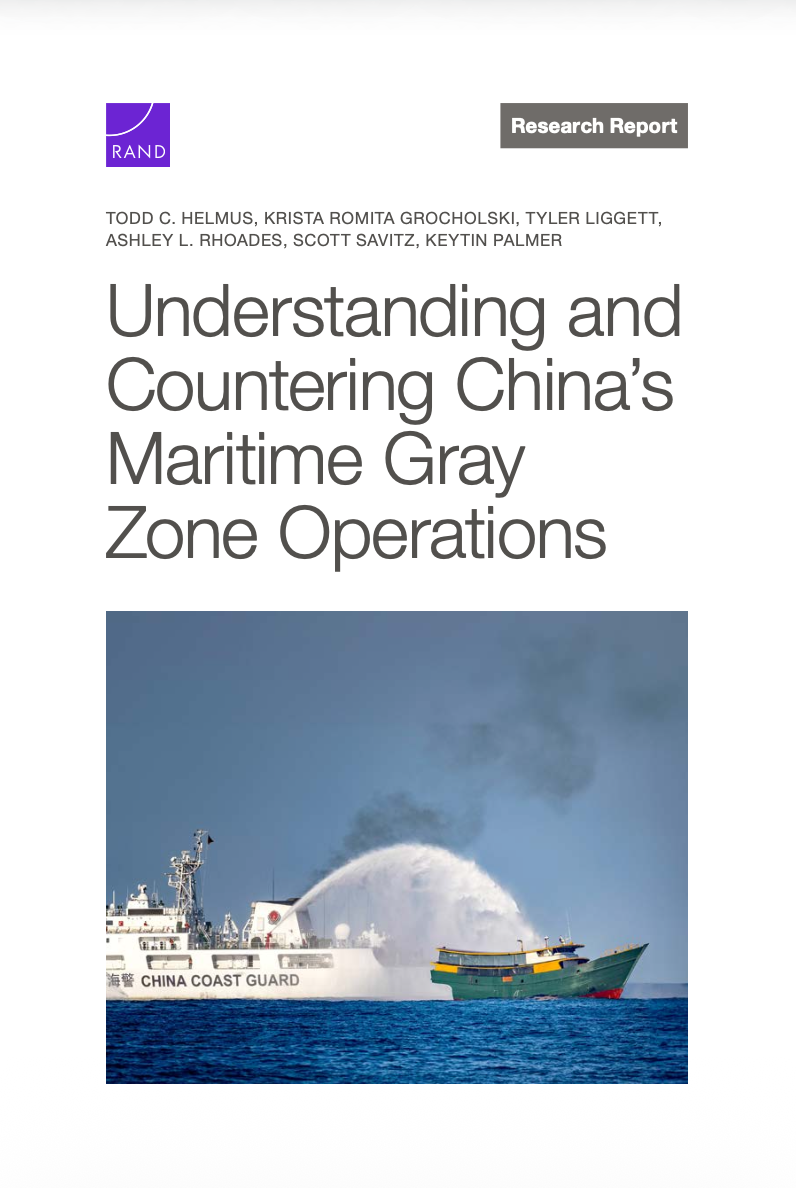
Understanding and Countering China’s Maritime Gray Zone Operations
This RAND report identifies four pathways for countering China's South China Sea gray zone operations—presence, transparency, partner capacity-building, and non-lethal weapons—and warns that a U.S. focus on potential kinetic war risks losing a gray zone conflict in which China secures effective sovereignty without firing a shot.
An Exploratory Examination of Agent-Based Modeling for the Study of Social Movements
This RAND report uses agent-based modeling and case studies from Egypt, Syria, and Hong Kong to explore how information technologies accelerate social movement formation and reshape the dynamics of collective action.
Advising the Command: Best Practices from the Special Operations Advisory Experience in Afghanistan
Drawing from the NATO Special Operations advisory mission in Afghanistan, the research highlights best practices across the full advisory lifecycle — from pre-deployment training through continuity of operations across rotations.
Development and Pilot Test of the RAND Program Evaluation Toolkit for Countering Violent Extremism
This RAND report introduces the Program Evaluation Toolkit for Countering Violent Extremism, built from a literature review, a program taxonomy, manager interviews, and pilot testing, to give community-based CVE programs the user-friendly checklists, worksheets, and templates needed to choose the most rigorous evaluation approach they can sustain and produce evidence on whether to improve, scale, or discontinue their activities.

Veteran Narratives of Support for Extremist Groups and Beliefs: Results from Interviews with Members of a Nationally Representative Survey of the U.S. Veteran Community
This RAND report draws on 2023 follow-up interviews with veterans who had endorsed extremist beliefs in a 2022 survey, finding that negative and traumatic experiences during service and transition are tightly interwoven with their paths into extremism—pointing to policy implications that will require further research to operationalize.
A House Reunited: Prospects for Bipartisanship in a Divided Country
The research team convened workshops bringing together participants with divergent political views to identify areas of consensus across four critical policy domains: mis- and disinformation, election security, extremism, and immigration reform.
Enlisting Madison Avenue: The Marketing Approach to Earning Popular Support in Theaters of Operation
Washington Post front page. Introduced private-sector branding and audience segmentation to military strategic communications. Foundational reference for a generation of military IO professionals.
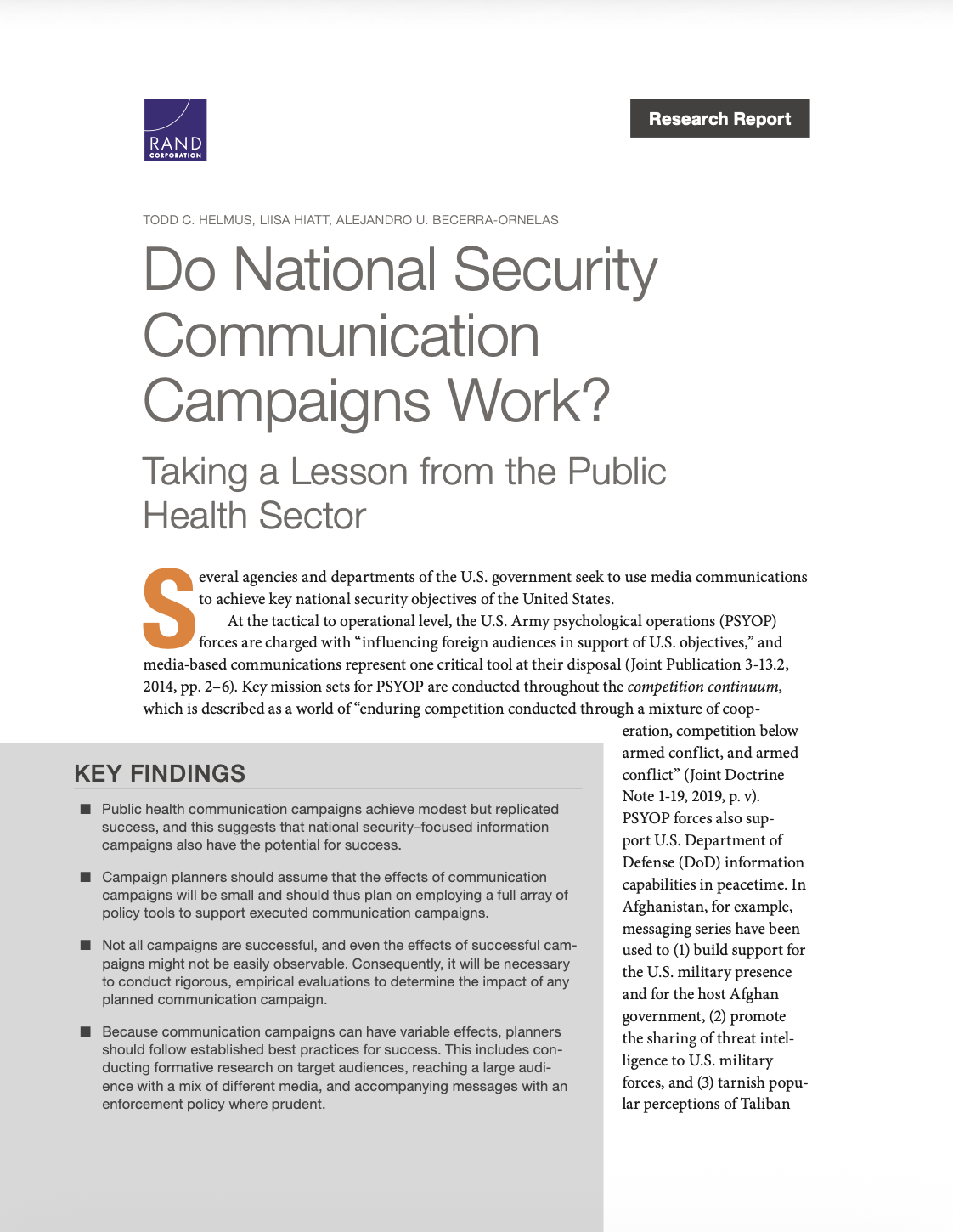
Do National Security Communication Campaigns Work? Taking a Lesson from the Public Health Sector
This RAND report mines a systematic review of 41 public health communication campaign meta-analyses for lessons applicable to U.S. national security communications, including the Army's psychological operations inform, influence, and persuade campaigns.
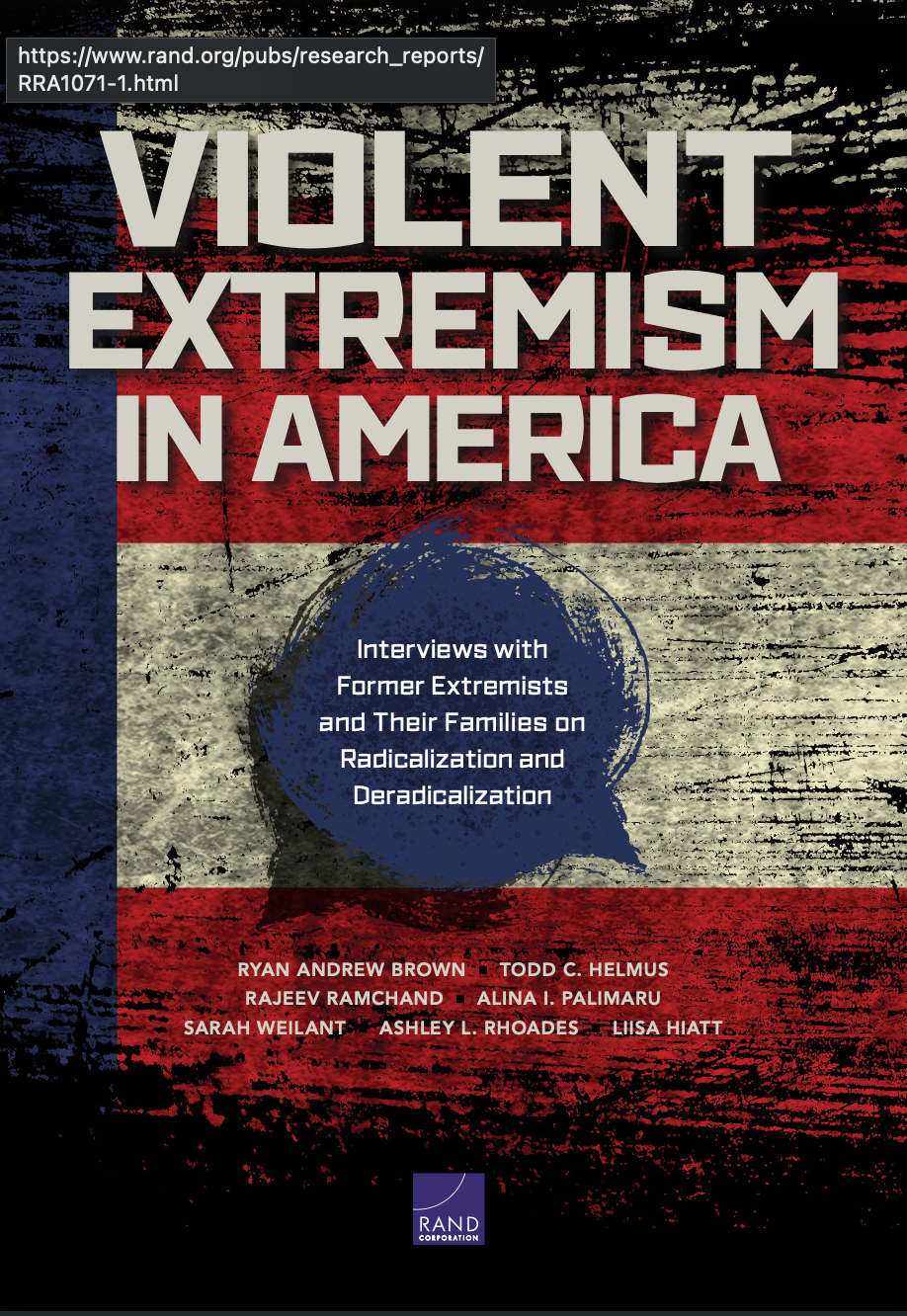
Violent Extremism in America: Interviews with Former Extremists and Their Families on Radicalization and Deradicalization
This RAND report draws on interviews with 32 former extremists and family members to map how people enter and exit extremist groups, finding that propaganda exposure is widespread, white supremacists typically self-recruit while Islamic extremists are more often pulled in top-down, and exits are usually supported by another person providing emotional, cultural, or material stability.
Artificial Intelligence, Deepfakes, and Disinformation: A Primer
Foundational resource used across the national security and technology communities to understand AI-generated threats to information integrity.
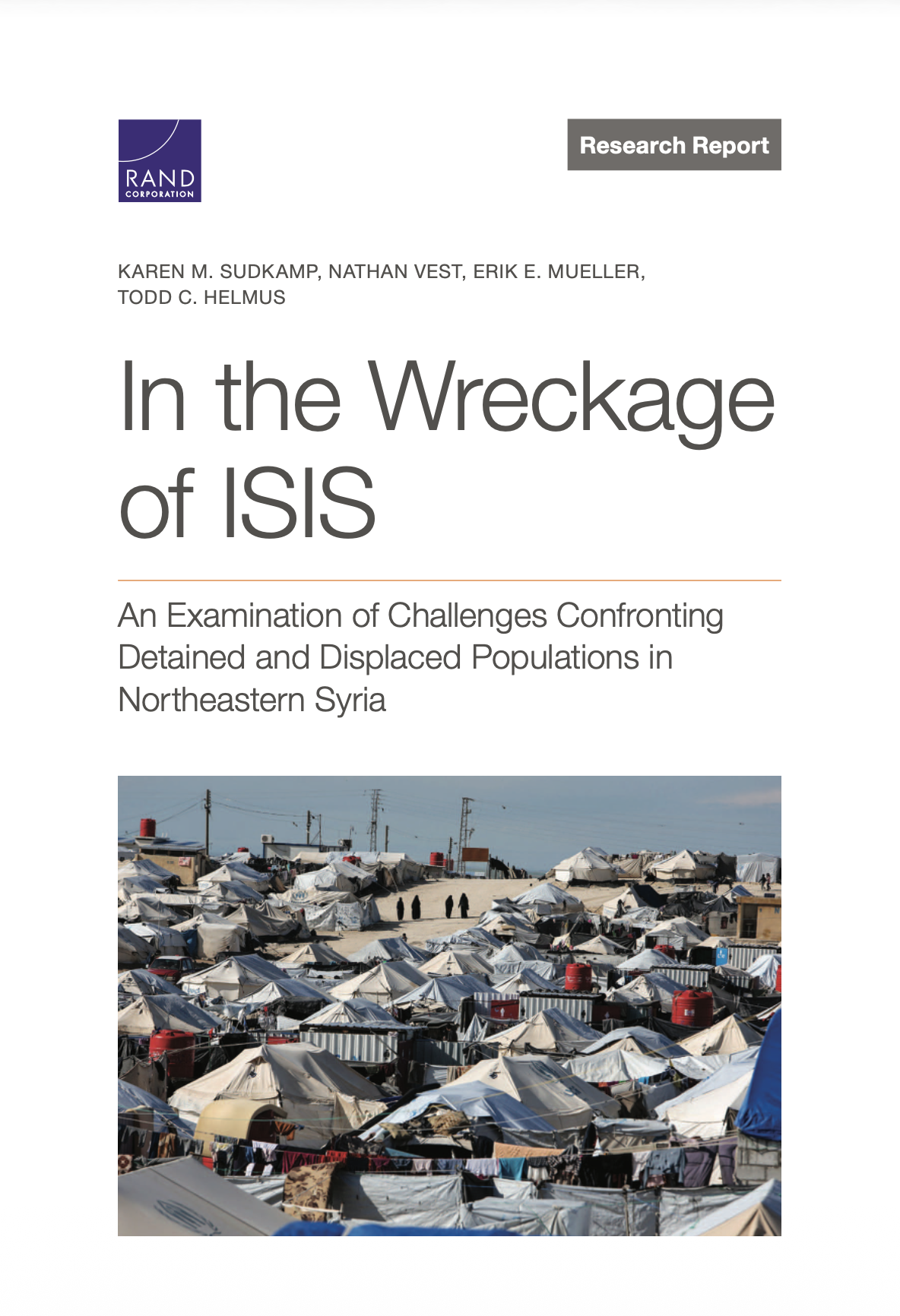
In the Wreckage of ISIS: An Examination of Challenges Confronting Detained and Displaced Populations in Northeastern Syria
This RAND report examines al-Hol and Roj camps in northeastern Syria, where ideologically mixed populations face radicalization risks from poor conditions, weak security, and external ISIS connections, and recommends legal-status processes, resourced judicial systems, repatriation pathways for vulnerable adolescents, an international donor fund, and greater integration with targeted isolation of the most radicalized residents.
What Prevention and Treatment of Substance Use Disorder Can Tell Us About Addressing Violent Extremism
This RAND Perspective draws on psychology, neuroscience, sociology, and public health evidence to argue that violent extremism shares meaningful features with substance addiction—persistent intrusive thoughts, situational triggers, and relapse risk—and uses that parallel to point toward new prevention and deradicalization approaches.
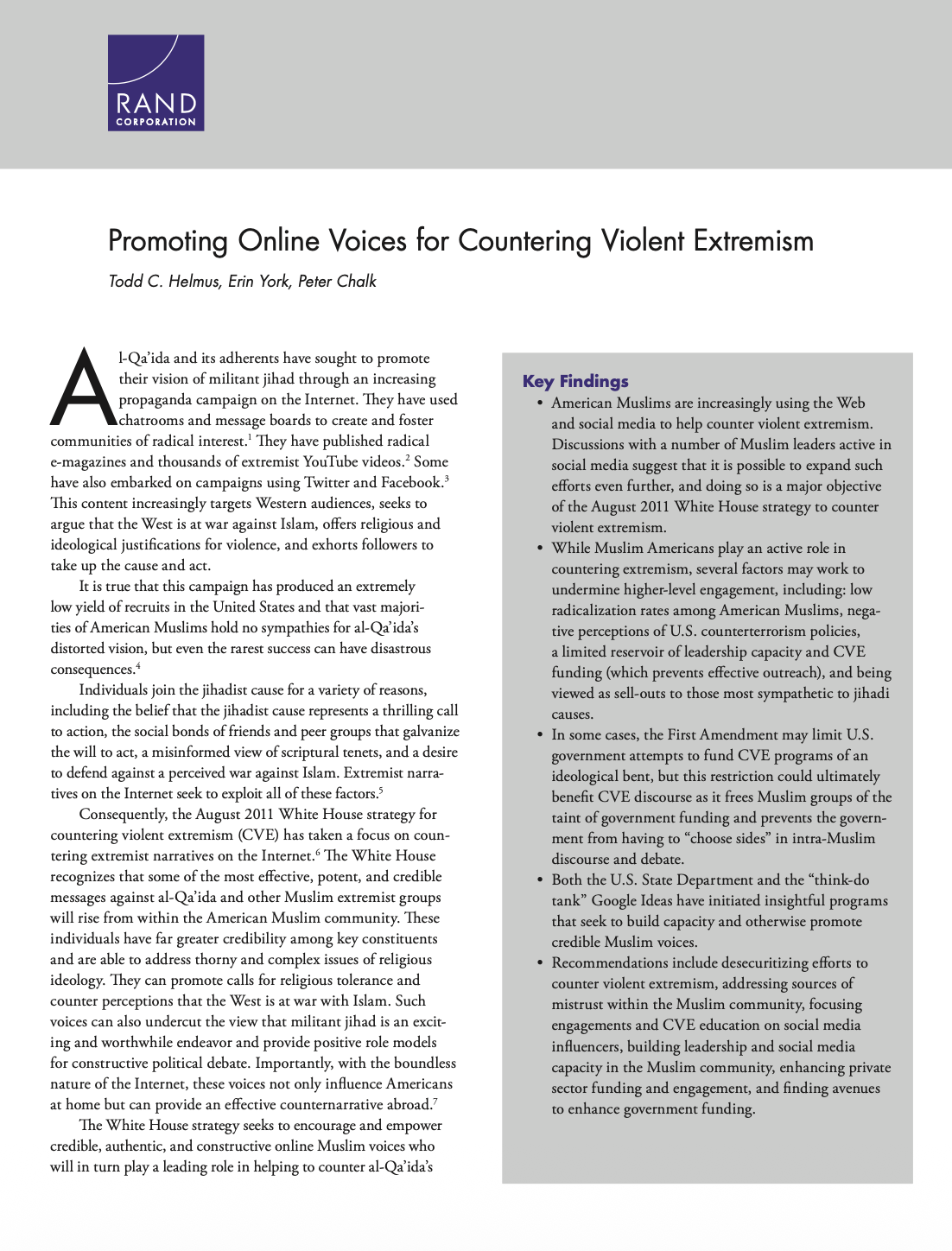
Promoting Online Voices for Countering Violent Extremism
This RAND report—which has influenced U.S. National Counterterrorism Center policy—argues that American Muslim CVE efforts online succeed when government and private funders act as facilitators rather than orchestrators, and recommends reducing CVE's national security framing, addressing community mistrust, investing in influential social media voices, and expanding both private and government funding.
Generative AI Threats to Democracy and Potential Policy Responses
Guided U.S. Senate deliberations on regulatory initiatives to address generative AI risks to democratic institutions and information ecosystems.
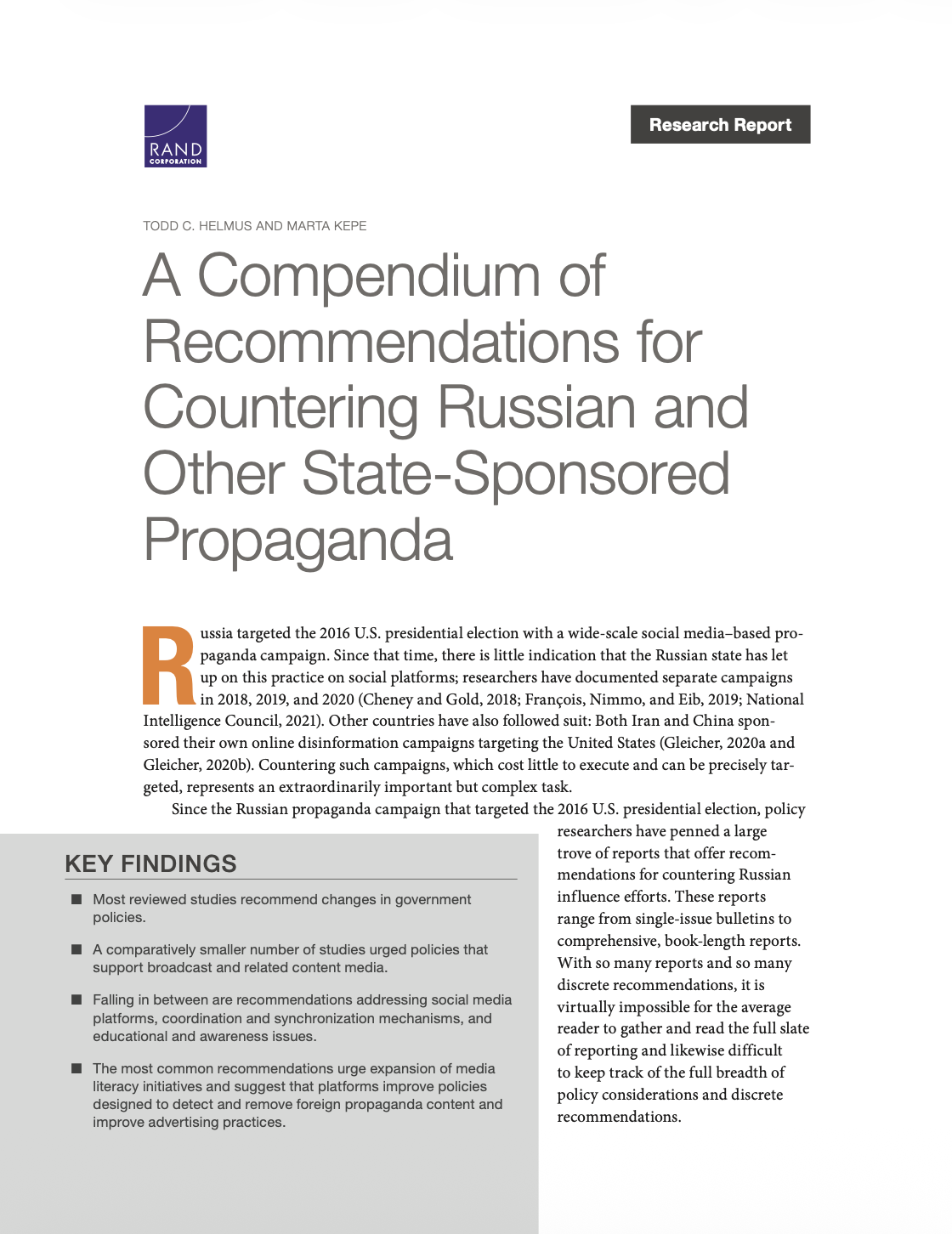
A Compendium of Recommendations for Countering Russian and Other State-Sponsored Propaganda
RAND’s analysis that distilled recommendations from 64 policy papers for countering Russian and state-sponsored propaganda helped directly inform U.S. government policy for responding to adversary information operations.
Modern Political Warfare: Current Practices and Possible Responses
This RAND report draws on case studies of Russia, Iran, and ISIS to characterize modern political warfare and recommends reframing the U.S. response as integrated statecraft led by an enabled State Department, with deeper DoD–State integration, stronger MISO and intelligence capabilities, and persistent special operations presence in vulnerable regions.
Russian Social Media Influence: Understanding Russian Propaganda in Eastern Europe
Established new methodology for measuring the impact of social media influence operations. Research contributed to personal sanctions by the Russian Federation in 2022.

How the United States Can Support Allied and Partner Efforts to Counter China in the Gray Zone
This RAND report examines how Southeast and East Asian states respond to China's gray-zone coercion and recommends the U.S. reinforce regional will through security commitments and transparency support, build resilience through alternative investment, and expand military and coast guard capacity while reconsidering assumptions that direct confrontation inevitably escalates.