
Searchable Publication List
Empowering ISIS Opponents on Twitter
This RAND Perspective draws on lessons from commercial marketing influencer strategies to identify recommendations for empowering ISIS opponents on Twitter.
Detecting Conspiracy Theories on Social Media: Improving Machine Learning to Detect and Understand Online Conspiracy Theories
This RAND report for Google Jigsaw develops a hybrid linguistic and rhetorical machine-learning model that substantially improves detection of online conspiracy theory language, and argues that because conspiracy theories often hook into legitimate concerns and "us versus them" framings, direct contradiction backfires—making transparent empathetic engagement, correction of false news, outreach to moderate adherents, and addressing underlying fears more effective responses.
Countering Foreign Interference in U.S. Elections
This RAND report, the fourth in a four-part series for the California Governor's Office of Emergency Services, examines how U.S. voters respond to Russian-sourced memes designed to inflame domestic divisions and to a public service announcement warning them about that kind of manipulation.
Prevalence of Veteran Support for Extremist Groups and Extremist Beliefs: Results from a Nationally Representative Survey of the U.S. Veteran Community
This RAND survey of nearly 1,000 veterans finds no evidence that the veteran community as a whole supports violent extremism at higher rates than the general public, but flags that most veterans endorsing political violence (17.7%) are not tied to any specific group—leaving them potentially exposed to recruitment by emerging movements—with Marine Corps veterans showing the highest support across services.

RAND Program Evaluation Toolkit for Countering Violent Extremism
Created the national standard for measuring CVE program effectiveness. Mandated by the Department of Homeland Security for all terrorism prevention grant recipients.
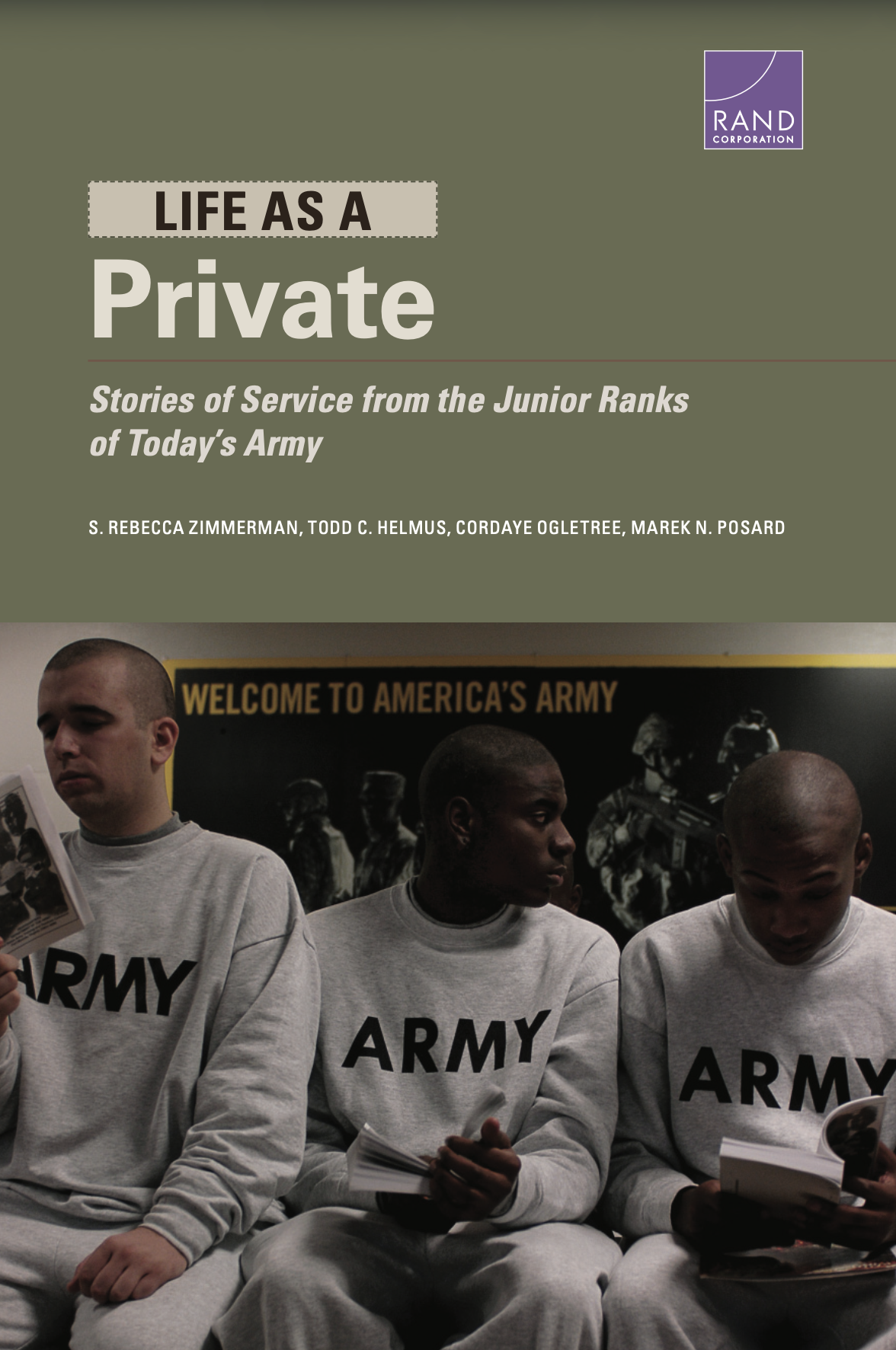
Life as a Private: Stories of Service from the Junior Ranks of Today’s Army
This RAND Arroyo Center report tells the stories of six junior enlisted soldiers in their own words, surfacing common themes around leaders who genuinely care, strong unit relationships, satisfying social lives (with real financial pressure for those with dependents), and the Army's transformative effect on the people who serve.

Life as a Private: A Study of the Motivations and Experiences of Junior Enlisted Personnel in the U.S. Army
This RAND Arroyo Center study of 81 junior enlisted soldiers finds that they join for family, institutional, and occupational reasons, value camaraderie and small-unit leadership above all, and report broad satisfaction with Army life—pointing to recommendations around foregrounding social bonds in the Army Value Proposition and reenlistment messaging, peer-network recruiting incentives, and more accurate pre-enlistment information.
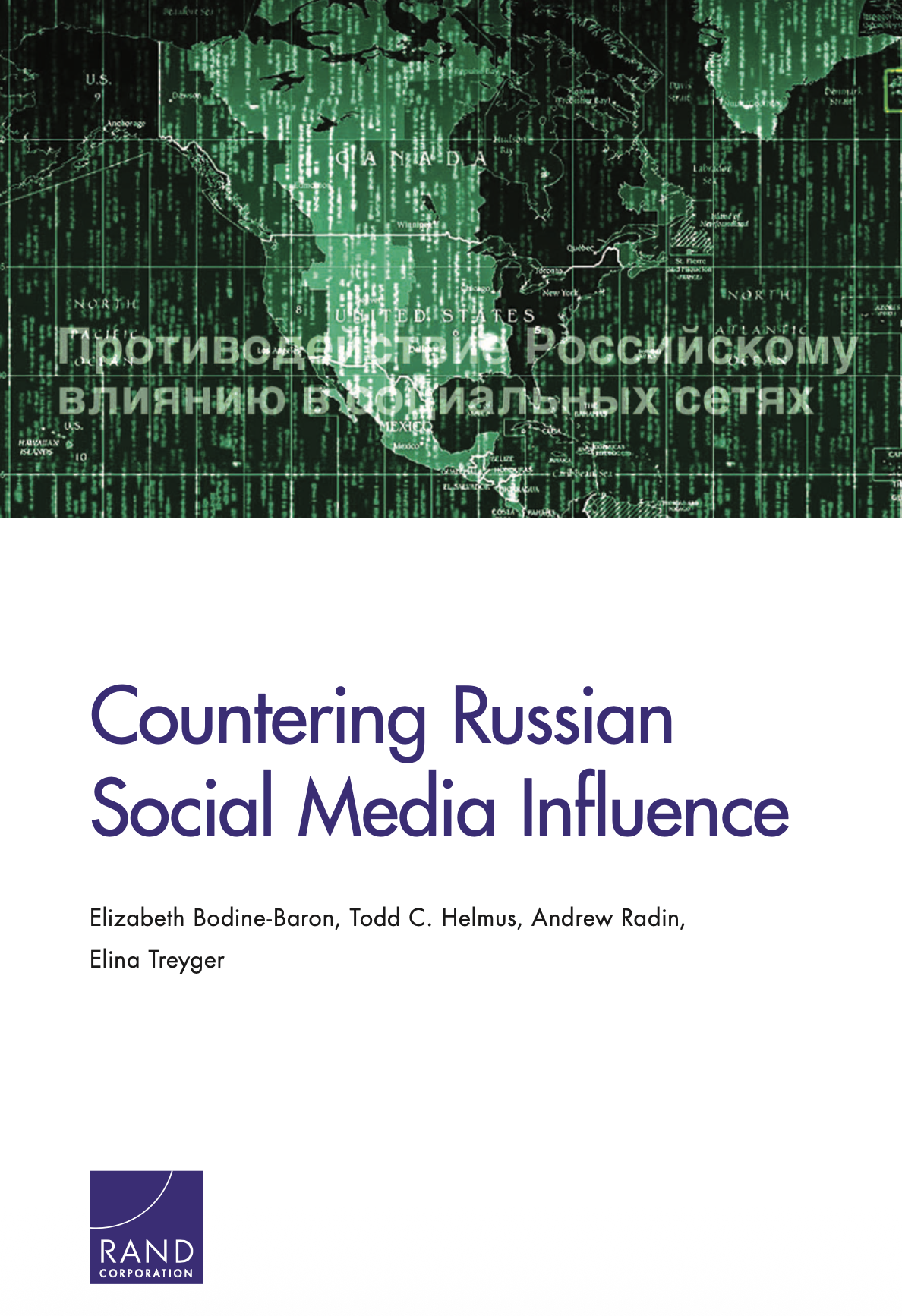
Countering Russian Social Media Influence
This RAND report frames Russian social media disinformation as a "disinformation chain" from Kremlin leadership through proxies and platforms to U.S. consumers, and argues that fragmented countermeasures across government, platforms, NGOs, and academia need to be replaced by clear norms, executive-legislative coordination, formal government-platform information sharing, greater platform transparency, and defensive measures prioritized over punitive ones.
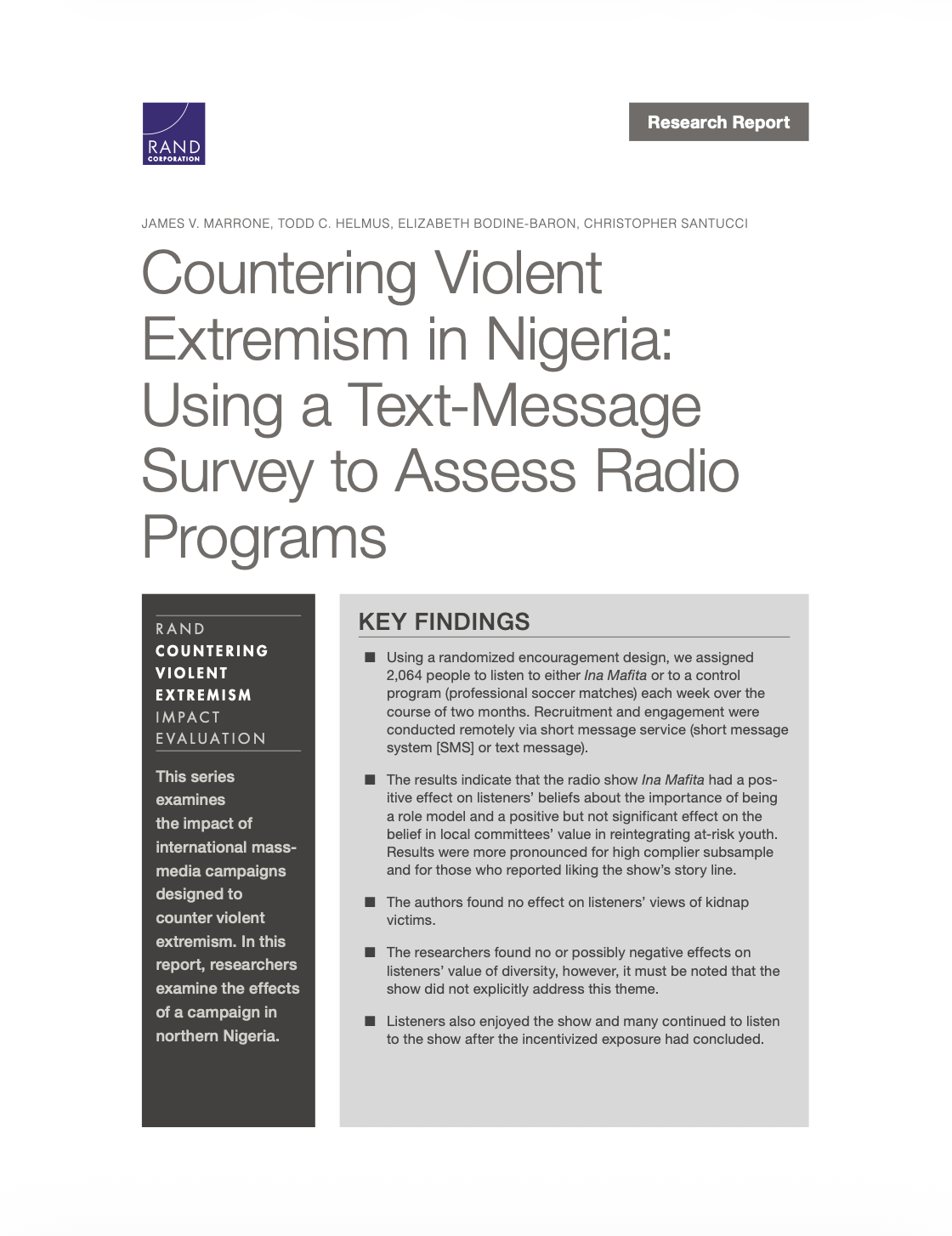
Countering Violent Extremism in Nigeria: Using a Test-Message Survey to Assess Radio Programs
This RAND report was part of a ground breaking set of studies that experimentally tested the impact of State Department counter violent extremism programs. This study, in a first of its kind, used text message surveys to assess the impact of CVE radio programs in Nigeria.
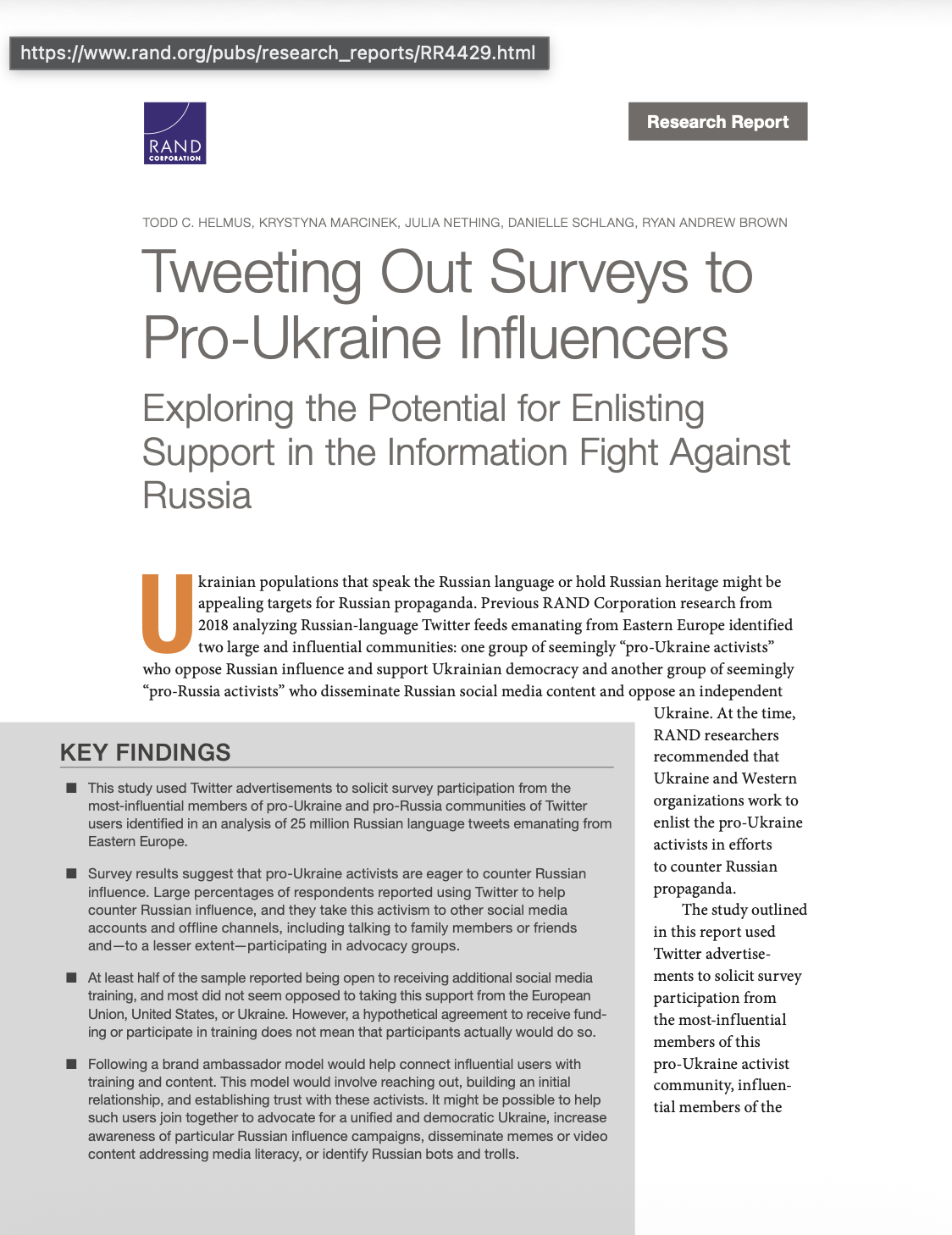
Tweeting Out Surveys to Pro-Ukraine Influencers: Exploring the Potential for Enlisting Support in the Information Fight Against Russia
This RAND survey of pro-Ukraine and pro-Russia Russian-language Twitter activists finds pro-Ukraine users already pushing back against Russian influence online and offline and open to outside training and support, pointing to a brand ambassador model for connecting influential activists with training, content, and coordinated counter-influence efforts.
Social Science for Counterterrorism: Putting the Pieces Together
The authors report on an aggressively interdisciplinary project to survey and integrate the scholarly social-science literature relevant to counterterrorism.
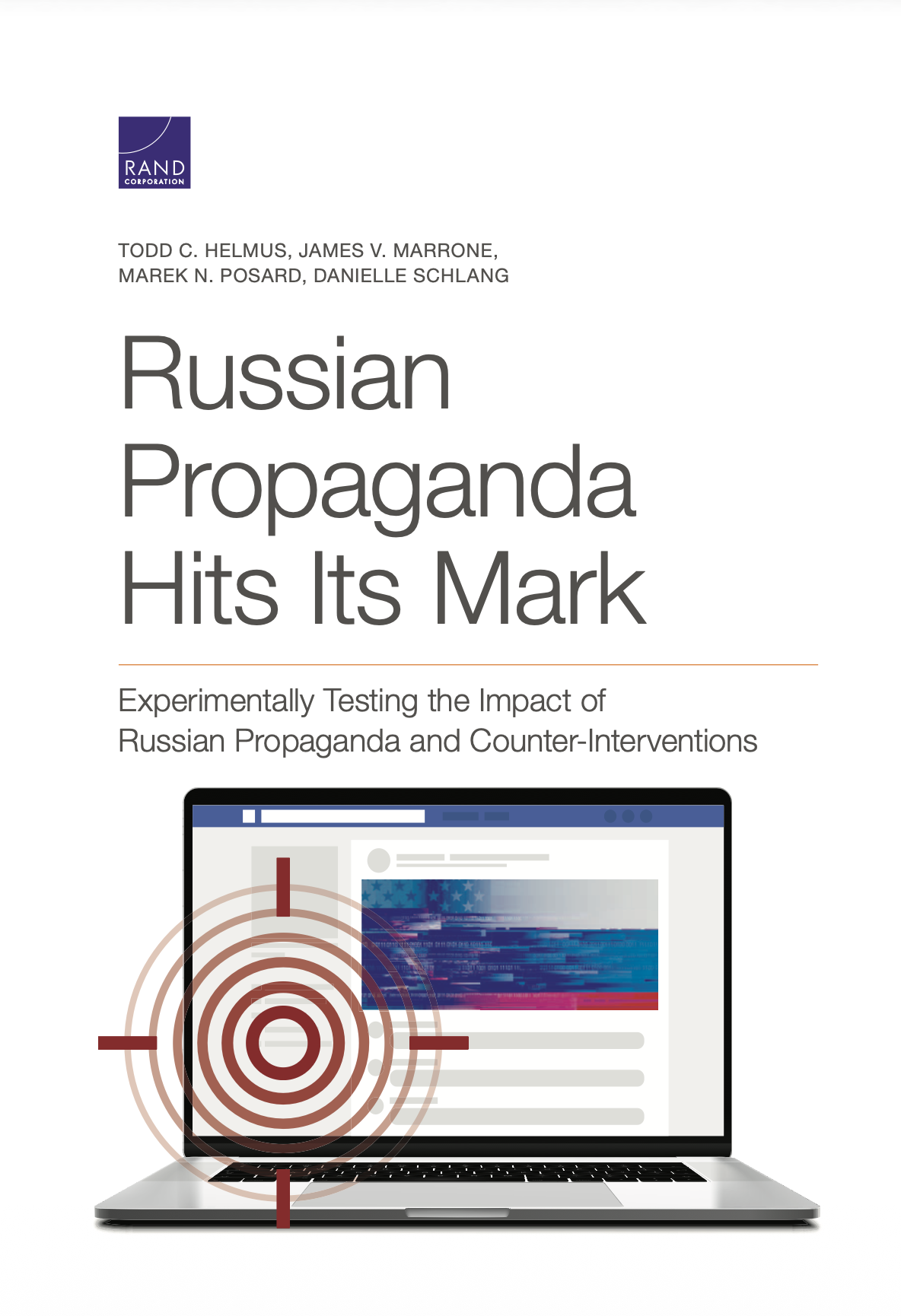
Russian Propaganda Hits Its MarkExperimentally Testing the Impact of Russian Propaganda and Counter-Interventions
We RAND randomized controlled trial using actual Russian propaganda finds that the content reliably elicits strong partisan reactions but that revealing its Russian source and showing a brief media literacy video reduce engagement—especially among Partisan Left and Partisan Right audiences—pointing to source-unmasking tools, generalized warnings, inoculation approaches, and scalable social media literacy as viable countermeasures.
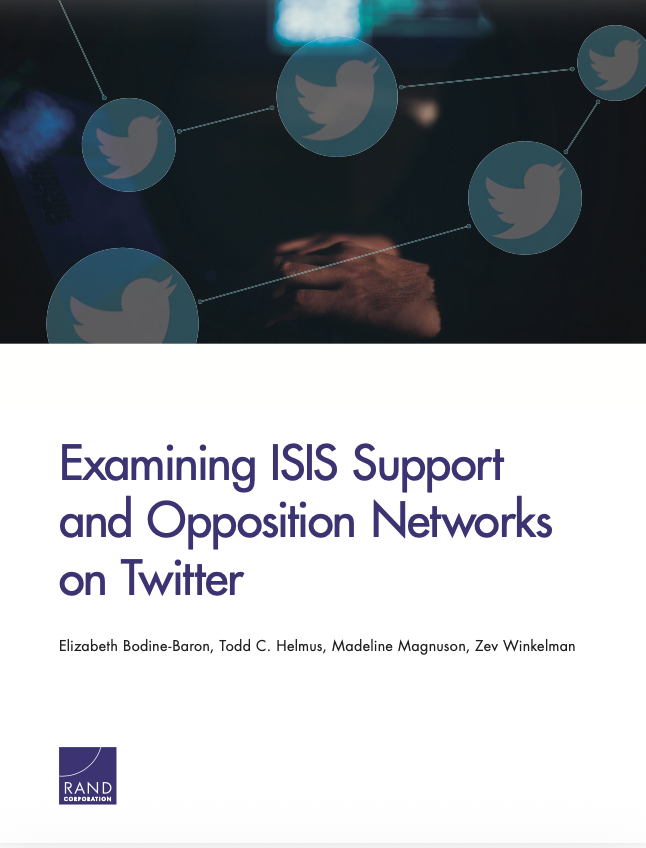
Examining ISIS Support and Opposition Networks on Twitter
Pioneered the integration of community detection algorithms with lexical fingerprinting for scaled adversary network identification on social media platforms.
From Consensus to Conflict: Understanding Foreign Measures Targeting U.S. Elections
This RAND report places Russian information efforts in the long history of foreign interference in U.S. politics and argues for replacing the field's fragmented focus on content, networks, or consumers with a holistic approach that anticipates likely target groups and builds evidence-based preventive practices around them.
Foreign Interference in the 2020 Election: Tools for Detecting Online Election Interference
This RAND report, the second in a series on foreign election interference, maps Twitter advocacy communities around the 2020 election and identifies likely interference through trolls and superconnector accounts that—while not definitively attributable—serve Russian interests and match Moscow's playbook of sowing division, with the authors recommending continued innovation in detection methods and public surfacing of threats, targets, and tactics.
Countering Violent Extremism in the Philippines: A Snapshot of Current Challenges and Responses
This RAND report surveys the threat picture and CVE programming in the Philippines, finding that entrenched poverty, communal divisions, and government grievances continue to drive radicalization while heavy-handed government counterterrorism risks fueling it further, non-kinetic government programs suffer from poor credibility and coordination, and nongovernmental efforts produce some wins but operate as microcampaigns without rigorous evaluation built in.
Countering Violent Extremism in Indonesia: using an Online Panel Survey to Assess a Social Media Counter-Messaging Campaign
This RAND evaluation was part of a ground breaking set of studies experimentally testing the impact of Department of State funded counter violent extremism programs.
Promoting Peace as the Antidote to Violent Extremism: Evaluation of a Philippines-Based Tech Camp and Peace Promotion Fellowship
This RAND evaluation of Equal Access International's Mindanao CVE training and Peace Promotion Fellowship finds high participant satisfaction and successful community-based projects, and recommends tighter program design, more dedicated coaching staff, contingency planning, attention to fellow credibility, and more rigorous evaluation.

Locals Rule: Historical lessons for Creating Local Defense Forces for Afghanistan and Beyond
This RAND study, created at the best of the senior special operations officer in Afghanistan, applied lessons from the history of local defense forces to support U.S. Village Stability Operations in Afghanistan and the Afghan Local Police.
The Role of Communication and Network Technologies in the Dynamics of Social Movements
This simulation study finds that communication technologies that spark spontaneous interaction help ignite social movements while networking technologies accelerate their intermediate-stage growth (with outreach proving most effective once agents can actively join), and that authorities can develop highly accurate beliefs about movements simply by observing network links rather than individual actors.