
Searchable Publication List
Ukrainian Resistance to Russian Disinformation: Lessons for Future Conflict
This RAND report uses Ukraine's wartime information and counter-disinformation efforts as a case study to distill lessons for how the U.S. national security establishment can prepare for and counter Russian-style disinformation during future contingency operations.
A Compendium of Recommendations for Countering Russian and Other State-Sponsored Propaganda
RAND’s analysis that distilled recommendations from 64 policy papers for countering Russian and state-sponsored propaganda helped directly inform U.S. government policy for responding to adversary information operations.
Modern Political Warfare: Current Practices and Possible Responses
This RAND report draws on case studies of Russia, Iran, and ISIS to characterize modern political warfare and recommends reframing the U.S. response as integrated statecraft led by an enabled State Department, with deeper DoD–State integration, stronger MISO and intelligence capabilities, and persistent special operations presence in vulnerable regions.
Russian Social Media Influence: Understanding Russian Propaganda in Eastern Europe
Established new methodology for measuring the impact of social media influence operations. Research contributed to personal sanctions by the Russian Federation in 2022.
Countering Foreign Interference in U.S. Elections
This RAND report, the fourth in a four-part series for the California Governor's Office of Emergency Services, examines how U.S. voters respond to Russian-sourced memes designed to inflame domestic divisions and to a public service announcement warning them about that kind of manipulation.
Countering Russian Social Media Influence
This RAND report frames Russian social media disinformation as a "disinformation chain" from Kremlin leadership through proxies and platforms to U.S. consumers, and argues that fragmented countermeasures across government, platforms, NGOs, and academia need to be replaced by clear norms, executive-legislative coordination, formal government-platform information sharing, greater platform transparency, and defensive measures prioritized over punitive ones.
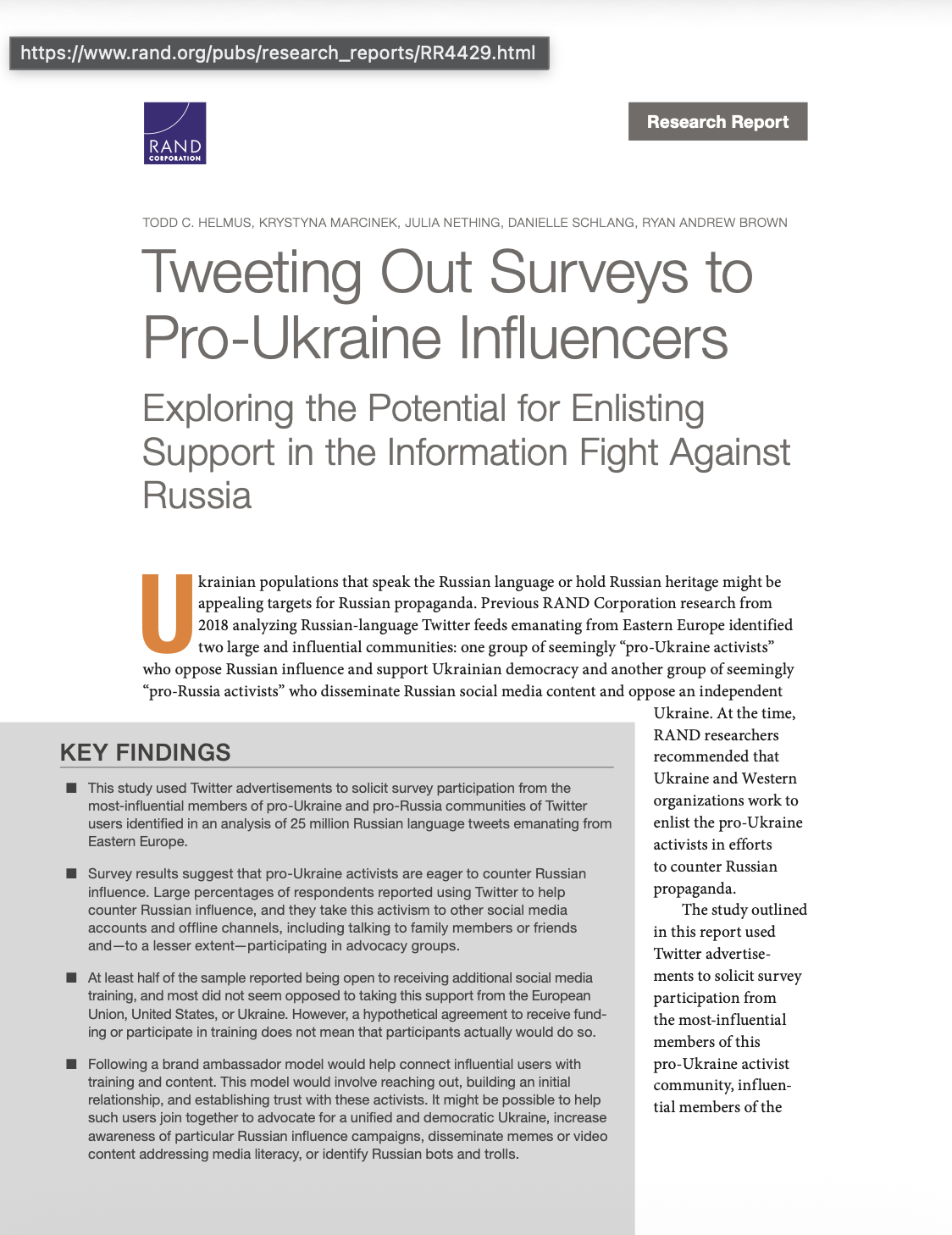
Tweeting Out Surveys to Pro-Ukraine Influencers: Exploring the Potential for Enlisting Support in the Information Fight Against Russia
This RAND survey of pro-Ukraine and pro-Russia Russian-language Twitter activists finds pro-Ukraine users already pushing back against Russian influence online and offline and open to outside training and support, pointing to a brand ambassador model for connecting influential activists with training, content, and coordinated counter-influence efforts.
Russian Propaganda Hits Its MarkExperimentally Testing the Impact of Russian Propaganda and Counter-Interventions
We RAND randomized controlled trial using actual Russian propaganda finds that the content reliably elicits strong partisan reactions but that revealing its Russian source and showing a brief media literacy video reduce engagement—especially among Partisan Left and Partisan Right audiences—pointing to source-unmasking tools, generalized warnings, inoculation approaches, and scalable social media literacy as viable countermeasures.
From Consensus to Conflict: Understanding Foreign Measures Targeting U.S. Elections
This RAND report places Russian information efforts in the long history of foreign interference in U.S. politics and argues for replacing the field's fragmented focus on content, networks, or consumers with a holistic approach that anticipates likely target groups and builds evidence-based preventive practices around them.
Foreign Interference in the 2020 Election: Tools for Detecting Online Election Interference
This RAND report, the second in a series on foreign election interference, maps Twitter advocacy communities around the 2020 election and identifies likely interference through trolls and superconnector accounts that—while not definitively attributable—serve Russian interests and match Moscow's playbook of sowing division, with the authors recommending continued innovation in detection methods and public surfacing of threats, targets, and tactics.