
Searchable Publication List
Enlisting Madison Avenue: The Marketing Approach to Earning Popular Support in Theaters of Operation
Washington Post front page. Introduced private-sector branding and audience segmentation to military strategic communications. Foundational reference for a generation of military IO professionals.
Do National Security Communication Campaigns Work? Taking a Lesson from the Public Health Sector
This RAND report mines a systematic review of 41 public health communication campaign meta-analyses for lessons applicable to U.S. national security communications, including the Army's psychological operations inform, influence, and persuade campaigns.
A Compendium of Recommendations for Countering Russian and Other State-Sponsored Propaganda
RAND’s analysis that distilled recommendations from 64 policy papers for countering Russian and state-sponsored propaganda helped directly inform U.S. government policy for responding to adversary information operations.
Modern Political Warfare: Current Practices and Possible Responses
This RAND report draws on case studies of Russia, Iran, and ISIS to characterize modern political warfare and recommends reframing the U.S. response as integrated statecraft led by an enabled State Department, with deeper DoD–State integration, stronger MISO and intelligence capabilities, and persistent special operations presence in vulnerable regions.
Russian Social Media Influence: Understanding Russian Propaganda in Eastern Europe
Established new methodology for measuring the impact of social media influence operations. Research contributed to personal sanctions by the Russian Federation in 2022.

How the United States Can Support Allied and Partner Efforts to Counter China in the Gray Zone
This RAND report examines how Southeast and East Asian states respond to China's gray-zone coercion and recommends the U.S. reinforce regional will through security commitments and transparency support, build resilience through alternative investment, and expand military and coast guard capacity while reconsidering assumptions that direct confrontation inevitably escalates.
Countering Russian Social Media Influence
This RAND report frames Russian social media disinformation as a "disinformation chain" from Kremlin leadership through proxies and platforms to U.S. consumers, and argues that fragmented countermeasures across government, platforms, NGOs, and academia need to be replaced by clear norms, executive-legislative coordination, formal government-platform information sharing, greater platform transparency, and defensive measures prioritized over punitive ones.
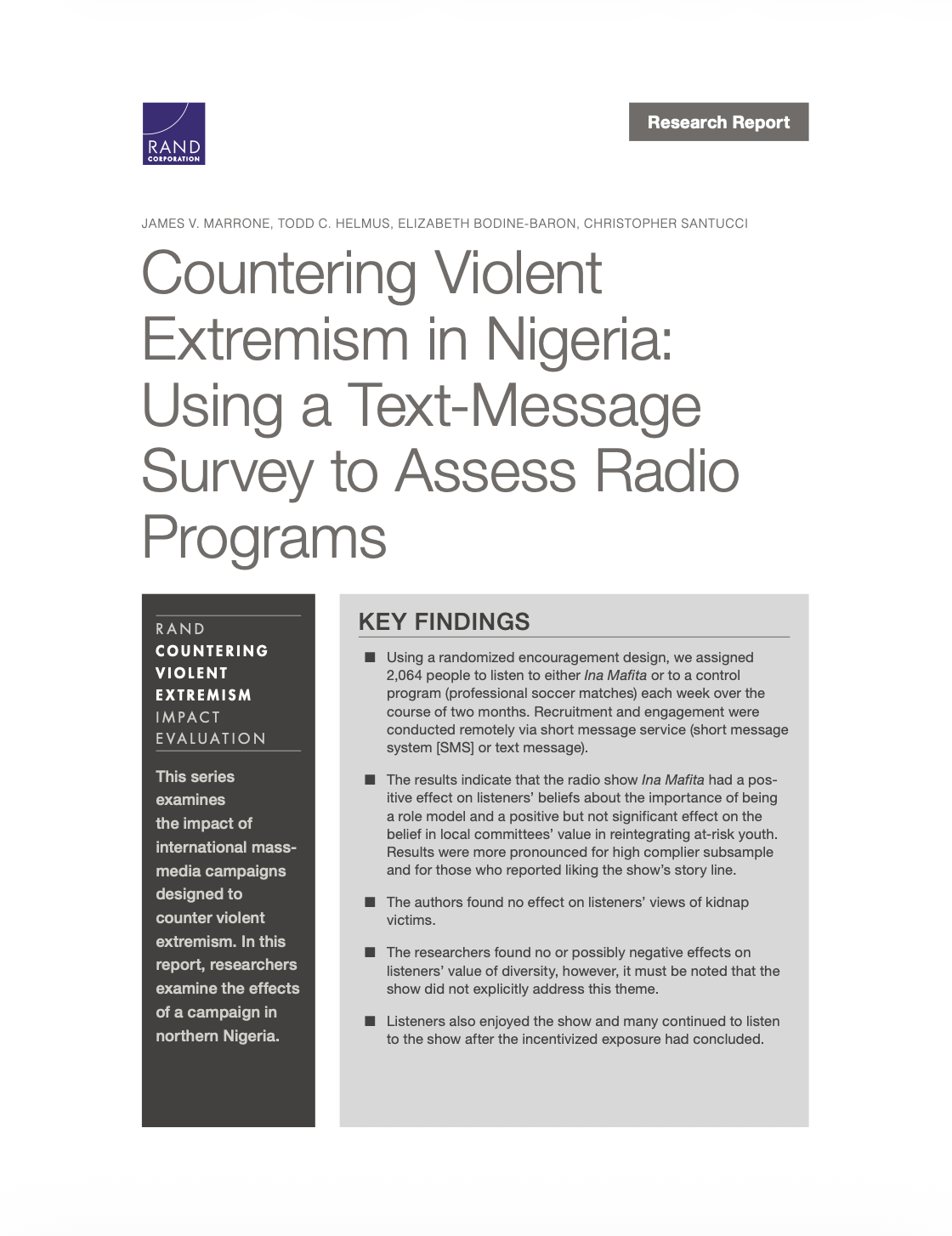
Countering Violent Extremism in Nigeria: Using a Test-Message Survey to Assess Radio Programs
This RAND report was part of a ground breaking set of studies that experimentally tested the impact of State Department counter violent extremism programs. This study, in a first of its kind, used text message surveys to assess the impact of CVE radio programs in Nigeria.
Countering Violent Extremism in Indonesia: using an Online Panel Survey to Assess a Social Media Counter-Messaging Campaign
This RAND evaluation was part of a ground breaking set of studies experimentally testing the impact of Department of State funded counter violent extremism programs.
Promoting Peace as the Antidote to Violent Extremism: Evaluation of a Philippines-Based Tech Camp and Peace Promotion Fellowship
This RAND evaluation of Equal Access International's Mindanao CVE training and Peace Promotion Fellowship finds high participant satisfaction and successful community-based projects, and recommends tighter program design, more dedicated coaching staff, contingency planning, attention to fellow credibility, and more rigorous evaluation.

Barriers to the Broad Dissemination of Creative Works in the Arab World
This monograph examines the barriers to the broad dissemination of such works, with a focus on Arabic literature, and suggests ways in which nongovernmental organizations, international allies, and the U.S. government can assist Arab writers and artists in overcoming these barriers.
China’s Role in the Global Development of Critical Resources
This RAND study examined Chinese foreign investment in critical resources and energy infrastructure—coal power in Indonesia, Pakistan, and South Africa; transmission and distribution in several Latin American countries; and global seabed mining—looking for evidence of the behaviors most often alleged: predatory contracting, strategic positioning, disregard for environmental and labor standards, and market-influencing disinformation.