
Searchable Publication List
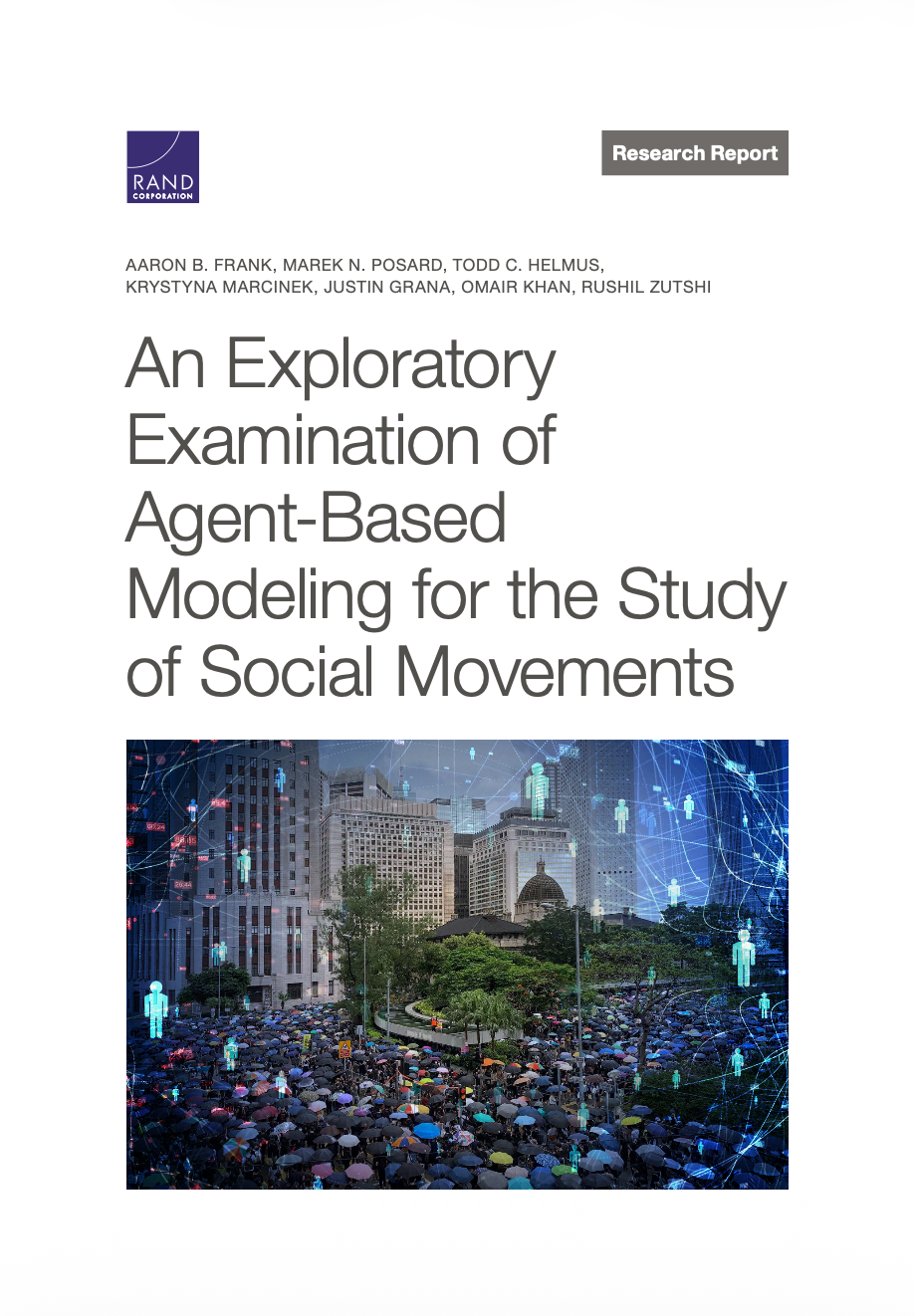
An Exploratory Examination of Agent-Based Modeling for the Study of Social Movements
This RAND report uses agent-based modeling and case studies from Egypt, Syria, and Hong Kong to explore how information technologies accelerate social movement formation and reshape the dynamics of collective action.
Promoting Online Voices for Countering Violent Extremism
This RAND report—which has influenced U.S. National Counterterrorism Center policy—argues that American Muslim CVE efforts online succeed when government and private funders act as facilitators rather than orchestrators, and recommends reducing CVE's national security framing, addressing community mistrust, investing in influential social media voices, and expanding both private and government funding.
Empowering ISIS Opponents on Twitter
This RAND Perspective draws on lessons from commercial marketing influencer strategies to identify recommendations for empowering ISIS opponents on Twitter.
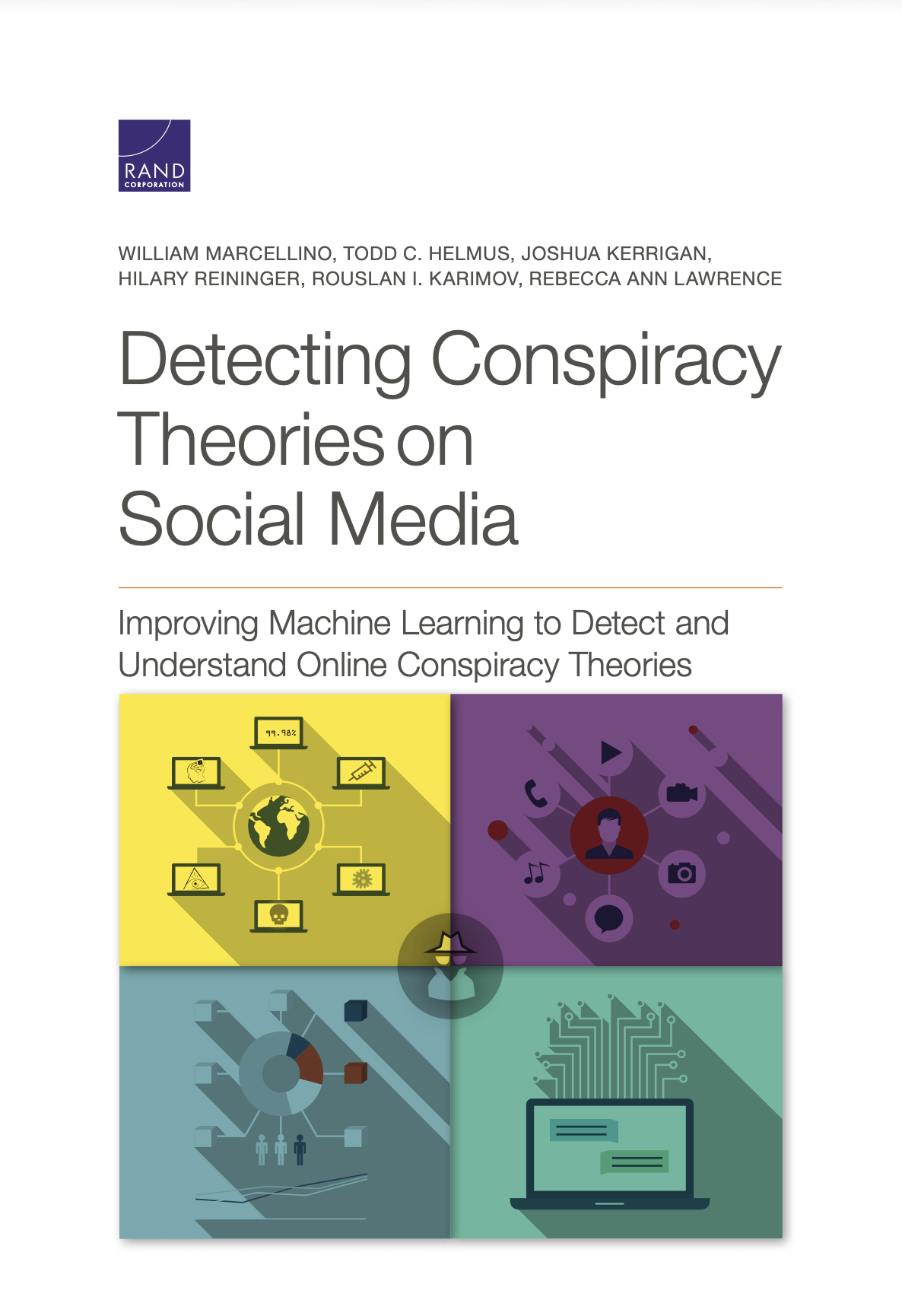
Detecting Conspiracy Theories on Social Media: Improving Machine Learning to Detect and Understand Online Conspiracy Theories
This RAND report for Google Jigsaw develops a hybrid linguistic and rhetorical machine-learning model that substantially improves detection of online conspiracy theory language, and argues that because conspiracy theories often hook into legitimate concerns and "us versus them" framings, direct contradiction backfires—making transparent empathetic engagement, correction of false news, outreach to moderate adherents, and addressing underlying fears more effective responses.
Countering Foreign Interference in U.S. Elections
This RAND report, the fourth in a four-part series for the California Governor's Office of Emergency Services, examines how U.S. voters respond to Russian-sourced memes designed to inflame domestic divisions and to a public service announcement warning them about that kind of manipulation.
Countering Russian Social Media Influence
This RAND report frames Russian social media disinformation as a "disinformation chain" from Kremlin leadership through proxies and platforms to U.S. consumers, and argues that fragmented countermeasures across government, platforms, NGOs, and academia need to be replaced by clear norms, executive-legislative coordination, formal government-platform information sharing, greater platform transparency, and defensive measures prioritized over punitive ones.
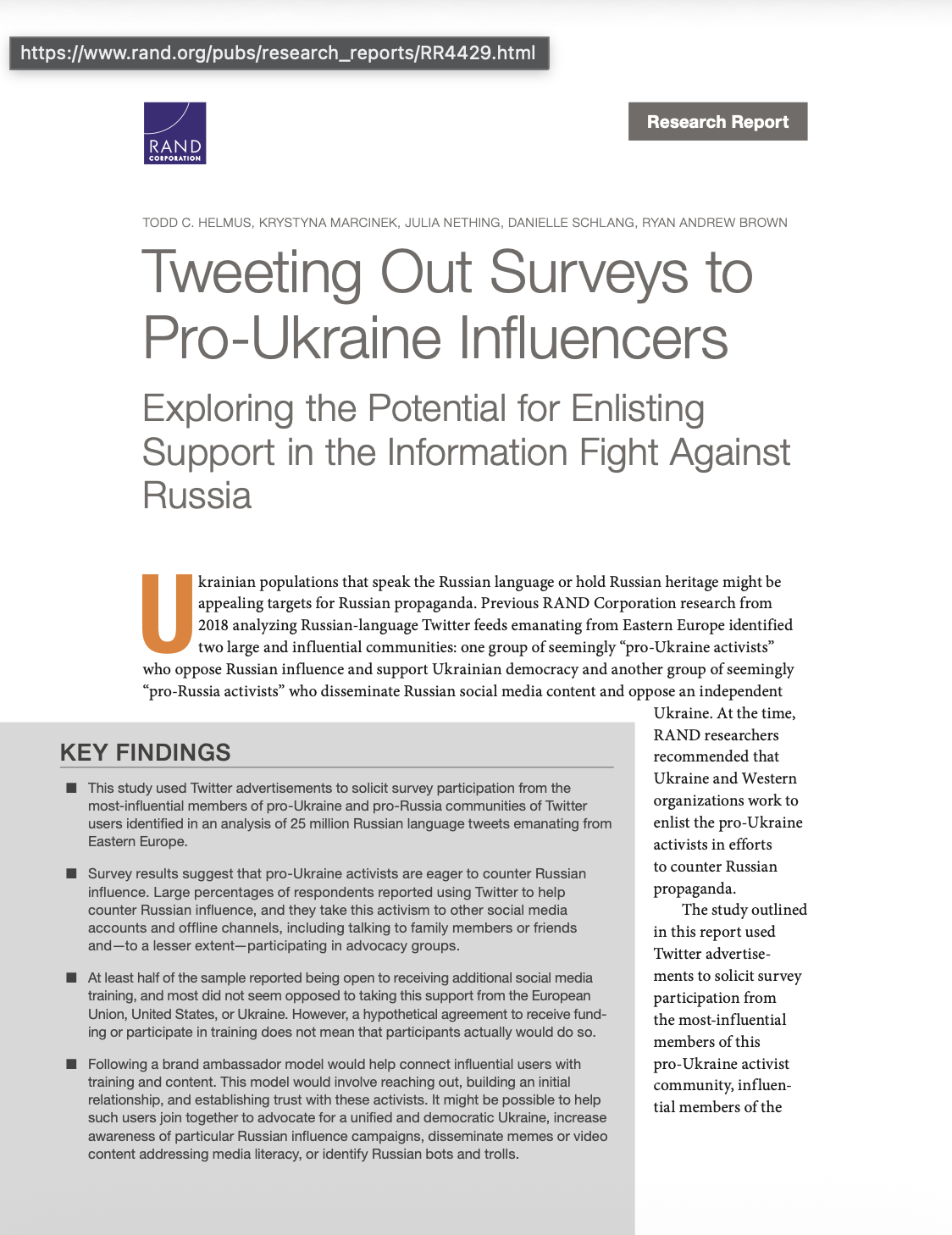
Tweeting Out Surveys to Pro-Ukraine Influencers: Exploring the Potential for Enlisting Support in the Information Fight Against Russia
This RAND survey of pro-Ukraine and pro-Russia Russian-language Twitter activists finds pro-Ukraine users already pushing back against Russian influence online and offline and open to outside training and support, pointing to a brand ambassador model for connecting influential activists with training, content, and coordinated counter-influence efforts.
Examining ISIS Support and Opposition Networks on Twitter
Pioneered the integration of community detection algorithms with lexical fingerprinting for scaled adversary network identification on social media platforms.
The Role of Communication and Network Technologies in the Dynamics of Social Movements
This simulation study finds that communication technologies that spark spontaneous interaction help ignite social movements while networking technologies accelerate their intermediate-stage growth (with outreach proving most effective once agents can actively join), and that authorities can develop highly accurate beliefs about movements simply by observing network links rather than individual actors.
Counter-Radicalization Bot Research: Using Social Bots to Fight Violent Extremism
This RAND report asks whether social bots—automated accounts capable of detecting targets and delivering counter-messaging at scale—could help close that narrow window. The answer: technically feasible, but the harder questions are legal, ethical, and geopolitical.
Assessing Outcomes of Online Campaigns Countering Violent Extremism: A Case Study of the Redirect Method
This RAND assesses the Redirect Method, which uses targeted ads to divert users searching for violent jihadist or far-right content toward counter-narrative videos and it offers recommendations for improving evaluations of online campaigns.